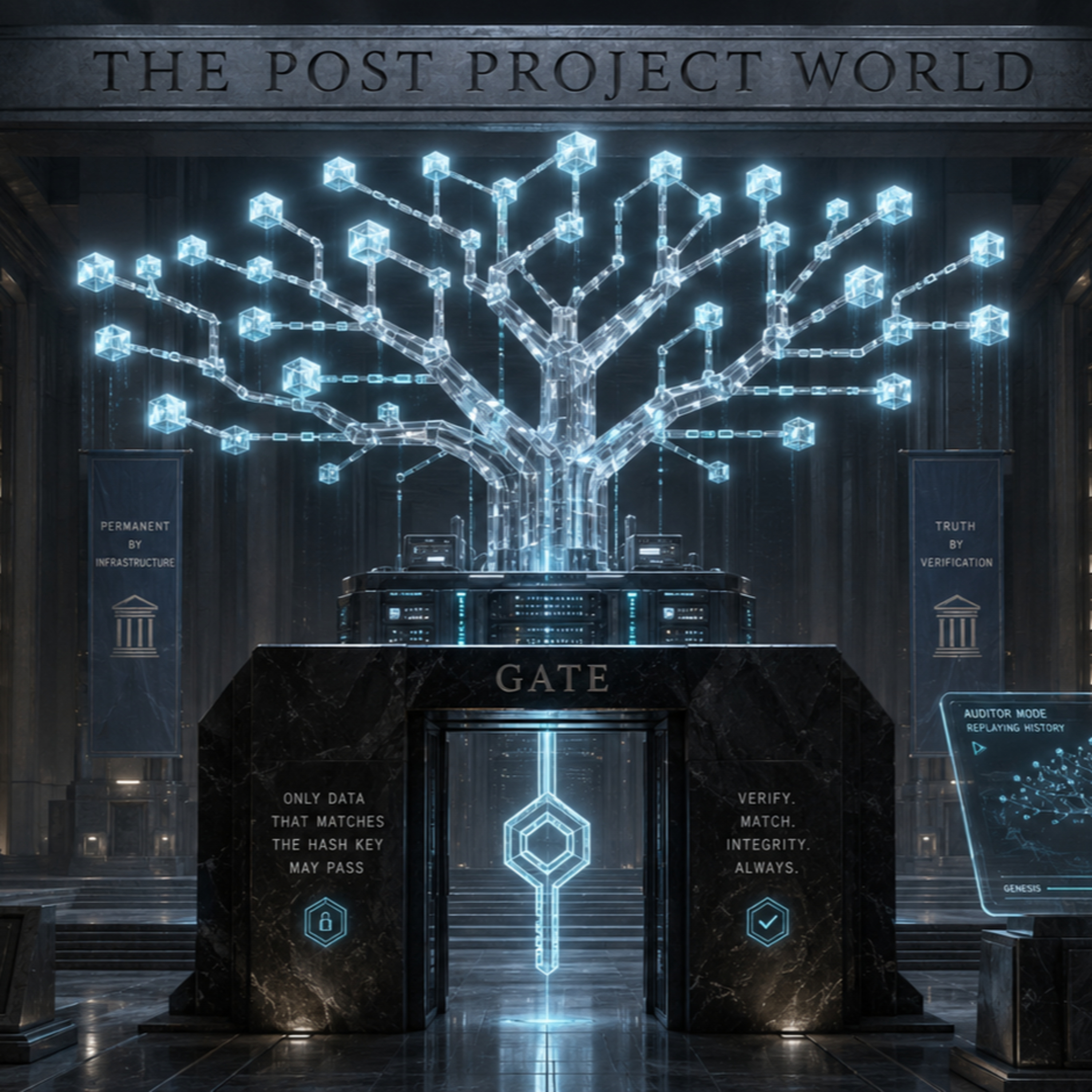
OrbaOS Deep Dive: Proving FRTB & GloBE for the Post-Project World
13 July 2026 · 00:50:43
In this extended 50-minute technical session, we explore why institutional regtech must move toward falsifiable lineage . For bank CROs and Group Tax Directors, the challenge is no longer just the calculation—it is the provenance . We break down the OrbaOS doctrine ("Admitted Before Calculated") and its application across two of the most complex regulatory regimes today: the Fundamental Review of the Trading Book (FRTB) and OECD Pillar Two (GloBE) . Key Technical Topics: The Merkle DAG Architecture: Why every capital or tax figure must be a node in a hash tree to prevent "silent drift". FRTB Standardised & Internal Models: Handling sensitivities, default risk, and liquidity horizons with regulator-template exports. GloBE Article 5 Walks: Navigating the jurisdictional top-up process from book profit to GIR XML export. QDMTT / IIR / UTPR Routing: How the engine uses OECD-published facts to determine exactly which jurisdiction collects top-up tax. Self-Hosted Governance: Deploying Postgres + FastAPI + React within your own network to ensure data residency and security. For FRTB: frtb.orbaos.com For GloBE: globe.orbaos.com "Your regulator can replay our exports offline with a single Python file. No backend access required." Keywords: FRTB, OECD Pillar Two, GloBE Model Rules, RegTech, Market Risk, Basel 3.1, Merkle DAG, QDMTT, IIR, UTPR, GIR XML, Bank Capital, Tax Governance, PRA SS21/15, EBA COREP, APRA APS 116. Call to Action: Institutional risk and tax leaders can request access to a private demo tenant to walk the doctrine end-to-end on synthetic data. Podcast Episode Chapter Timestamps 00:00 – 05:00 | Opening: Institutional Infrastructure in the Post-Project World: Framing the shift from temporary consulting "projects" to permanent, living infrastructure. Why OrbaOS is built for a world where "one-and-done" compliance is no longer enough. 05:00 – 12:00 | The Reconciliation Crisis: Why FRTB and Pillar Two Programs Fail: A deep dive into the operational failure modes where Risk, Finance, and Audit cannot agree on input rows. Discussing why "most FRTB programmes don’t fail on the math — they fail on reconciliation". 12:00 – 22:00 | The Doctrine: Admissibility Before Calculation: Technical breakdown of the Merkle DAG and the hash-echo commit flow. Explaining why "admitted before calculated" is the core governing principle of the engine. 22:00 – 32:00 | FRTB Specialist Segment: SA, IMA, and Regulator-Ready Exports: Walkthrough of the SBM, DRC, and RRAO modules, alongside the Internal Models (IMA) pipeline including Expected Shortfall and RFET. How exports map to PRA, EBA, and APRA templates. 32:00 – 42:00 | Pillar Two Specialism: Article Walks and Top-Up Routing: Detailed navigation of the Article 3.2 and 4.1 walks, Article 9 safe harbors, and the deterministic routing of QDMTT, IIR, and UTPR based on OECD Central Record facts. 42:00 – 47:00 | Operational Governance: The Warn-Gate-Block Path: How to deploy the system without breaking legacy paths. Moving from observational logging to strict four-eyes control and eventually "fail-closed" production. 47:00 – 50:00 | The Verification Replay & Demo Tenant Experience: How to use the standalone verify_lineage.py for offline audit replay and an invitation to the 45-minute private demo tenant for experiential proof.
The critical repairs had passed. The book had not. In the third and final episode documenting the reconstruction of a seven hundred and eighty-eight page FX options reference, Luigi Pascal Rondanini follows the work beyo…
An audit identifies defects. It does not prove that the repairs are correct. In Episode One I set three AI systems against my forthcoming FX options book and let the strongest one audit it. That audit produced one thousa…
I gave three advanced AI systems the same task: audit the formulas, calculations and worked examples in my forthcoming professional book on FX options. Claude, Codex and Kimi. Seven hundred and sixty-four typeset pages, …