
I arrived at my desk at 7:30 AM, hoping for two hours of focused work before the meetings began. I knew those quiet hours were precious—and increasingly rare.
By 8:00 AM, three Slack messages had interrupted my concentration. By 8:30, I'd responded to twelve emails, none of which required my actual expertise—they just needed my awareness. At 9:00, my first meeting began: a status update where eight people spent forty-five minutes sharing information that existed in three different dashboards, if anyone had time to look at them.
By noon, I had attended four meetings, sent thirty-seven emails, updated two status reports, and mediated a minor conflict between teams who didn't realize they were working on interdependent deliverables. I had not yet done any of the strategic thinking my role supposedly required.
This day wasn't unusual. It was typical.
The Hidden Cost
Think about your last week at work. How much of it was spent actually creating value—building something, solving a problem, serving a customer? And how much was spent coordinating—in meetings, on email chains, updating status reports, waiting for approvals?
If you're like most knowledge workers, the ratio is troubling.
Microsoft's research analyzed over 31,000 workers and found that the average employee spends 57% of their time in meetings, emails, and chats. Only 43% went to focused work. For managers, the coordination percentage climbed above 70%.
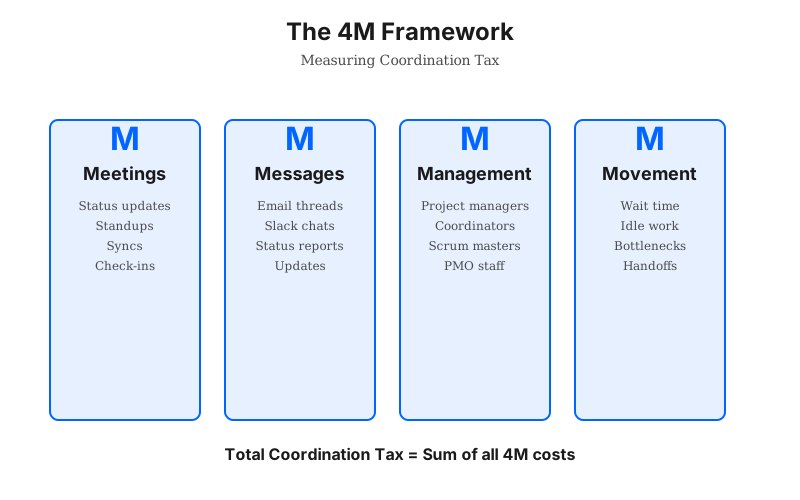
Calculate your own coordination tax:
- Meetings — Total person-hours in coordination meetings
- Messages — Time spent on coordination emails and chat
- Management — Dedicated coordination headcount
- Movement — Time work spends waiting vs. being worked on
What Coordination Actually Costs
Let me walk you through the coordination overhead I documented on one of my own projects—a treasury system implementation with a $5 million budget.
Weekly meetings alone: 63 person-hours.
That's equivalent to 1.6 full-time employees doing nothing but sitting in meetings. Over 18 months, that's approximately $735,000 at a blended rate of $150/hour.
Add status reporting (23 hours/week), ad hoc coordination (41 hours/week), and the total weekly coordination overhead reached 127 person-hours.
For a $5 million project, coordination overhead consumed approximately $1.4 million. That's 28% of the budget spent on making sure everyone knew what everyone else was doing.
"AI doesn't just automate tasks—it changes the economics of coordination so fundamentally that our organizational structures will have to follow."
What Happened When I Stopped
Two years ago, I started experimenting with a different approach.
Instead of weekly status meetings, I implemented AI-generated daily briefings that synthesized information from our actual work tools. Instead of asking people to report status, I let the system observe it. Instead of scheduling meetings to make decisions, I created clear decision tiers.
The results:
Meeting time dropped by roughly 70%. We went from 63 person-hours of weekly meetings to about 15.
Decisions happened faster. A vendor question that used to wait five days for the Tuesday sync now got resolved in hours.
The team was happier. People preferred knowing the AI was tracking flow and would flag problems. It felt less like surveillance and more like having a competent assistant.
This experience became the foundation for OrbaOS.