
Download in-depth case studies, executive briefs, and practical tools to understand how organizations are moving beyond traditional project management.
Case Studies
Detailed analysis of how major organizations eliminated project management and achieved coordination capital efficiency.
Netflix: Context Over Control
How Netflix eliminated project managers and replaced them with transparent information systems. Includes analysis of their strategy document culture, decision-making processes, and coordination infrastructure.
Download Case Study (PDF) →Spotify: Autonomous Squads Model
Deep dive into Spotify's squad, tribe, chapter, and guild structure. How they achieved autonomous coordination at scale without traditional project management hierarchies.
Download Case Study (PDF) →Haier: The Rendanheyi Revolution
How a 40,000-person Chinese appliance manufacturer dismantled its hierarchy and reorganized into 4,000+ autonomous microenterprises. Complete analysis of their market-based coordination model.
Download Case Study (PDF) →GitHub: Asynchronous by Default
How GitHub operates without traditional project managers through written communication, transparent decision-making, and platform-enabled coordination.
Download Case Study (PDF) →Tesla & SpaceX: Rapid Iteration Model
Analysis of how Tesla and SpaceX achieve rapid iteration and coordination without traditional project management structures. Focus on their engineering culture and decision velocity.
Download Case Study (PDF) →Executive Briefs
CCR Executive Brief
10-page board-level brief on Coordination Capital Ratio, threshold diagnostics, and governance migration priorities.
View & Download →Board Brief: Coordination Capital Risk
Director-focused briefing with CCR economics, margin sensitivity framing, and governance questions for board oversight.
Download Board Brief (PDF) →Books & Guides
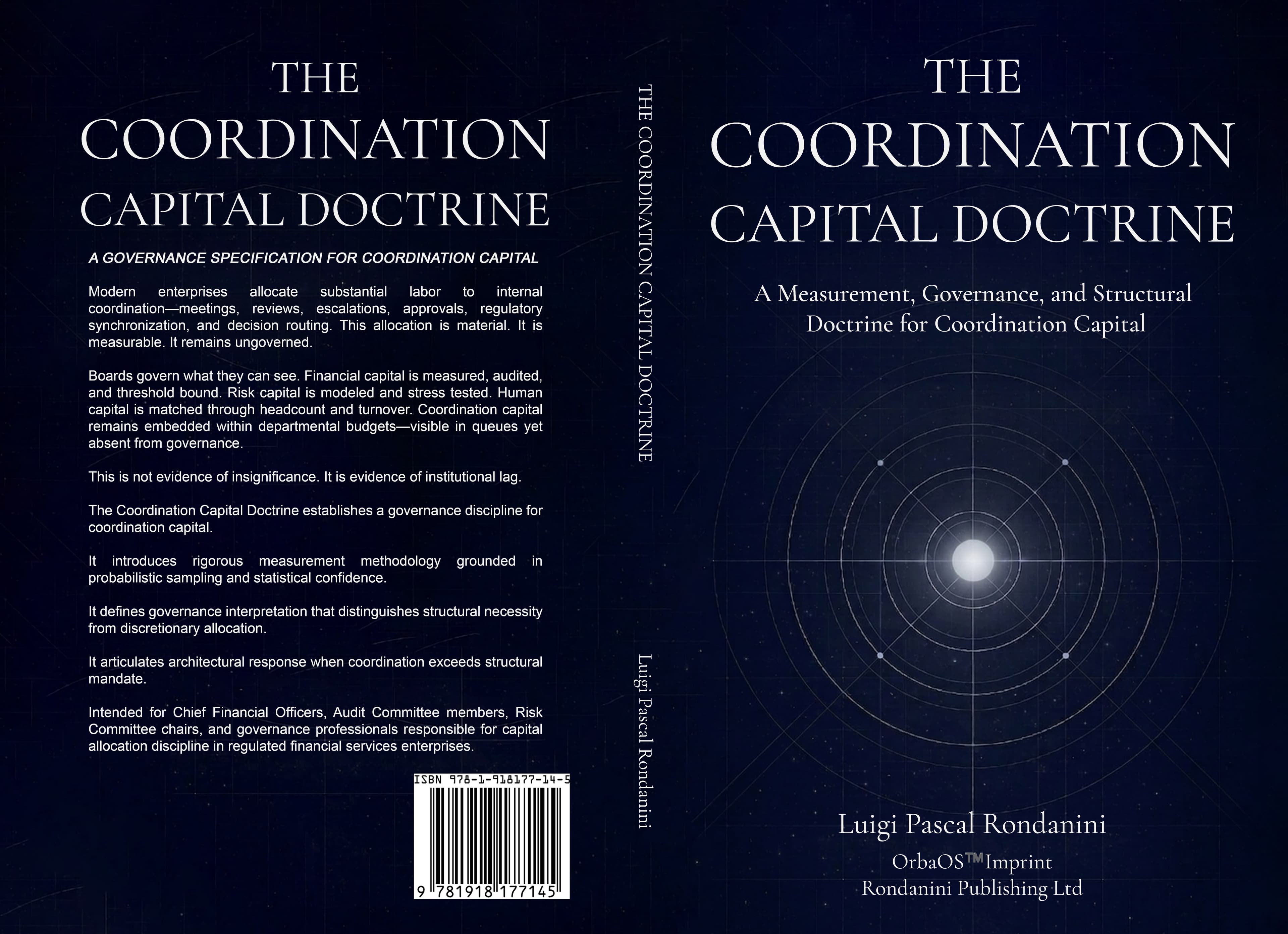
The Coordination Capital Doctrine
The first governance doctrine for coordination capital — introducing the CCR, Structural Floor, and Coordination Drift as fiduciary instruments for CFOs, Chief Audit Executives, and Risk Committee Chairs in regulated financial institutions.
The Coordination Capital Doctrine establishes coordination as a measurable, governable form of institutional capital — not a cost to be tolerated, but a structural allocation requiring the same fiduciary discipline applied to financial and operational capital.
Drawing on nearly thirty years of direct exposure to regulated financial services environments, Luigi Pascal Rondanini formalises the first governance specification for coordination capital: a doctrine that defines how coordination should be measured, governed, and reported at the board and audit committee level.
The book introduces the Coordination Capital Ratio (CCR), the Structural Floor, and Coordination Drift — three instruments that allow CFOs, Chief Audit Executives, and Risk Committee Chairs to impose governance discipline on an allocation that, in most regulated institutions, remains entirely unmeasured.
This is not a management methodology. It is a governance doctrine — designed for institutions where capital discipline is a fiduciary obligation, not a management preference.
Published by Rondanini Publishing Ltd under the OrbaOS™ Imprint.
Buy the book →Tools & Templates
OrbaOS Framework Workbook
Interactive worksheets, calculators, and planning tools for diagnosis and transition planning.
Open Workbook →Need More Information?
For access to additional case studies, industry-specific analyses, or custom research, contact us at contact@orbaos.com.